
Firestop solutions for clean room applications
Cleanrooms and dry rooms are among the most critical environments in modern manufacturing, supporting industries such as semiconductors, battery production, pharmaceuticals, and advanced electronics. This article explores the fire protection challenges in cleanrooms and dry rooms, outlines key performance considerations beyond fire resistance, and examines how engineered, system-based firestop solutions can support safety, compliance, environmental integrity, and long-term facility performance.
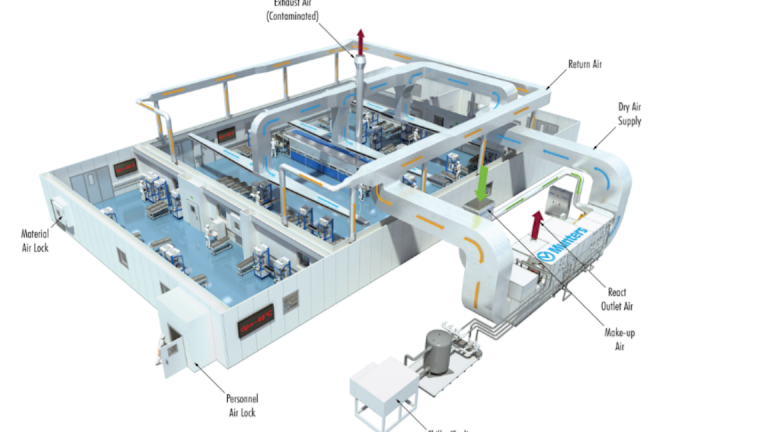
Fire Protection Challenges in Cleanrooms and Dry Rooms
In advanced manufacturing environments, success is often determined by factors that are invisible to the naked eye. Microscopic particles, subtle pressure fluctuations, humidity variations, and air leakage can significantly influence product quality, process reliability, and overall operational efficiency. Industries such as semiconductor manufacturing, lithium-ion battery production, pharmaceuticals, biotechnology, and precision electronics invest heavily in sophisticated environmental control systems to maintain optimal production conditions. Yet, despite these investments, one critical area frequently remains underestimated: the service penetrations that pass through walls, floors, and ceilings.
Every cable tray, conduit, pipe, and duct that penetrates a fire-rated barrier creates a potential pathway for unwanted movement of air, smoke, moisture, contaminants, and, in the event of an incident, fire. While these openings are essential for supporting modern manufacturing operations, they also represent vulnerabilities that can compromise both safety and environmental performance if not properly sealed. As manufacturing facilities continue to become more complex and technologically advanced, organizations are beginning to recognize that firestopping serves a much broader purpose than simply maintaining fire compartmentation.
The challenge is particularly pronounced in cleanrooms and dry rooms, where environmental stability is fundamental to operational success. These facilities rely on carefully engineered airflow patterns, pressure differentials, and humidity controls to ensure product integrity and process consistency. Even minor disruptions can have cascading effects throughout the manufacturing process. Consequently, firestop systems are increasingly being viewed not as passive construction elements, but as critical infrastructure components that actively contribute to contamination control, energy efficiency, operational continuity, and long-term facility resilience.
The Hidden Vulnerability in Controlled Environments
Modern cleanrooms and dry rooms are supported by extensive networks of electrical systems, automation controls, HVAC services, instrumentation, and process piping. Each of these systems requires penetrations through fire-rated assemblies, creating numerous interfaces where fire protection and environmental control must work together. While these penetrations may appear insignificant when viewed individually, their collective impact can be substantial.
A poorly sealed penetration can allow air leakage that disrupts carefully maintained pressure cascades, resulting in uncontrolled airflow between adjacent spaces. In cleanroom environments, this movement can facilitate the migration of airborne particles that threaten cleanliness classifications and process reliability. Within battery manufacturing dry rooms, even slight moisture ingress can affect environmental stability and potentially influence product quality. These risks extend beyond compliance concerns, directly affecting production yields, equipment performance, energy consumption, and operational costs.
As facilities become increasingly dependent on precision manufacturing processes, the role of penetration sealing expands accordingly. Firestopping is no longer solely about containing fire and smoke during an emergency. It has become a vital component of maintaining the environmental conditions necessary for day-to-day operations. The ability to preserve airtightness, support contamination control strategies, and protect humidity-sensitive environments is now just as important as achieving fire-resistance ratings.
Firestopping in Cleanrooms and Dry Rooms: Balancing Fire Protection and Environmental Performance
Traditional firestop systems were developed primarily to restore the fire-resistance performance of walls and floors after service penetrations had been installed. While this objective remains essential, controlled environments place additional demands on firestop technologies that extend far beyond fire safety requirements. Today's manufacturing facilities require solutions capable of delivering multiple layers of performance simultaneously.
A firestop system in a cleanroom or dry room must help maintain airtightness to preserve pressure differentials, resist moisture transfer to support humidity control, and minimize particle generation during both installation and maintenance activities. In many applications, compatibility with sensitive electronic equipment is also an important consideration, particularly in facilities where electromagnetic compatibility and electrostatic discharge control play critical roles. Equally important is the ability to accommodate future modifications without creating contamination risks or requiring extensive demolition.
These combined requirements have exposed the limitations of many conventional firestop approaches. Solutions that perform adequately in commercial buildings may not deliver the environmental performance necessary in advanced manufacturing facilities. As a result, project teams are increasingly seeking systems specifically engineered to address both fire protection and environmental integrity within a single solution.
The Rise of Engineered Modular Firestop Systems
The evolution of cleanroom and dry room design has driven significant innovation in firestop technology. Rather than relying on traditional field-fabricated solutions, many facility owners are now specifying engineered modular firestop systems developed specifically for critical environments. These systems are designed to provide consistent, repeatable performance while supporting the operational flexibility that modern manufacturing demands.
Modular cable transit systems, for example, enable high-density cable installations while maintaining reliable sealing performance. Because these systems are pre-engineered and standardized, they reduce installation variability and improve quality assurance outcomes. Fiber-free sealing technologies have also gained popularity due to their ability to minimize contamination risks during installation and future maintenance activities. By reducing the generation of airborne particles, these solutions align more closely with the stringent cleanliness requirements of controlled environments.
Reusable firestop components represent another important advancement. Manufacturing facilities are dynamic environments where equipment upgrades, process changes, and infrastructure expansions occur regularly. Traditional firestop methods often require removal and reconstruction whenever services are modified, generating debris and increasing downtime. Reusable systems allow penetrations to be opened and resealed efficiently, supporting operational continuity while preserving environmental integrity.
Mechanical transit systems further expand the capabilities of modern firestopping by combining fire resistance with airtightness, water resistance, and electromagnetic shielding. These integrated performance characteristics make them particularly valuable in facilities where reliability and environmental control are critical to ongoing operations.
Firestopping in Cleanrooms and Dry Rooms: Firestopping as a Contributor to Operational Excellence
The conversation surrounding firestopping has evolved significantly in recent years. While fire protection professionals remain key stakeholders, facility managers, operations teams, and manufacturing leaders are increasingly involved in penetration sealing decisions. This shift reflects a growing understanding that firestop performance directly influences operational outcomes.
Poorly designed or difficult-to-maintain firestop systems can complicate routine upgrades, increase maintenance costs, and introduce contamination risks during modifications. Conversely, engineered solutions can streamline maintenance activities, reduce disruption to production schedules, and improve overall facility adaptability. In high-value manufacturing environments where downtime can carry substantial financial consequences, these benefits become increasingly significant.
Organizations are also recognizing the relationship between airtight penetration sealing and energy efficiency. Air leakage through improperly sealed penetrations can place additional demands on HVAC systems, increasing energy consumption and operational costs. By helping maintain environmental control more effectively, high-performance firestop systems contribute not only to safety and compliance but also to sustainability objectives and long-term operational efficiency.
Firestopping in Cleanrooms and Dry Rooms: Engineering, Testing, and Long-Term Performance
Firestop systems used in controlled environments must satisfy multiple performance requirements simultaneously. While fire resistance remains the primary requirement, cleanrooms and dry rooms introduce additional operational considerations that directly influence system selection. International fire test standards such as ASTM E814, UL 1479, and equivalent EN fire classifications establish the requirements for fire resistance and compartmentation performance. However, cleanroom facilities often require additional project-specific performance criteria that go beyond conventional fire testing. These requirements commonly include airtightness, humidity control, particle containment, low outgassing characteristics, EMC compatibility, and support for future maintenance activities without generating excessive debris or operational disruption. Achieving reliable performance in cleanrooms and dry rooms requires a careful balance between tested fire protection capabilities and project-specific environmental requirements. Firestop systems should be supported by recognized fire testing standards and evaluated for their suitability within the intended operating environment. However, the complexity of modern manufacturing facilities often means that no two projects are identical. Unique service configurations, mixed penetrations, specialized environmental requirements, and evolving facility layouts frequently require a more collaborative engineering approach. Early engagement between designers, contractors, fire protection specialists, cleanroom consultants, and facility operators can help ensure that penetration sealing strategies align with both regulatory requirements and operational objectives. When firestop planning is integrated into the design process from the outset, facilities are better positioned to achieve long-term performance, maintainability, and compliance.

Call to action
As cleanroom and dry room technologies continue to advance, the expectations placed on every component within these facilities are rising. Firestopping can no longer be viewed as a hidden construction detail addressed solely to satisfy code requirements. It has become an essential contributor to environmental stability, process reliability, energy efficiency, and business continuity.
Every penetration within a controlled environment represents both a potential risk and an opportunity. When poorly designed, it can compromise safety, contamination control, humidity management, and operational performance. When engineered correctly, it strengthens the facility's ability to maintain critical conditions while supporting future growth and adaptation.
The most successful manufacturing facilities of the future will be those that recognize the strategic importance of these seemingly small details. By approaching firestopping as an integrated element of facility performance rather than a standalone compliance requirement, organizations can build environments that are not only safe, but also resilient, efficient, and prepared for the demands of tomorrow's manufacturing landscape.
As facilities continue to advance in complexity, project teams should evaluate firestopping as an integrated part of the overall cleanroom or dry room design strategy rather than a late-stage compliance requirement. Engaging experienced firestop specialists during the planning and design phases can help identify appropriate solutions, address project-specific performance requirements, and support long-term operational goals.
To learn how engineered firestop solutions can support both fire protection and controlled-environment performance in your facility, connect with Hilti's fire protection specialists for project-specific guidance and technical support.
References
https://www.iso.org/iso-14644-cleanrooms-and-associated-controlled-environments.html
https://www.shopulstandards.com/ProductDetail.aspx?productId=UL1479_4_X_20250430
https://www.uniquefirestop.com/ul-1479-standard-for-fire-tests-of-through-penetration-firestops/
https://firestop.org/wp-content/uploads/2025/07/Firestop_basics_penetrations_PEN2-.pdf
https://www.ul.com/sites/default/files/2024-10/Firestop-and-Joint-application-guide-final-draft-4-29-24pm-1.pdf