
Design and use of Post-Installed Reinforcement for Concrete-to-Concrete connections in Singapore
In today’s construction landscape, Post-Installed Reinforcement (PIR) has become an essential solution for connecting concrete elements cast at different times within reinforced concrete structures.
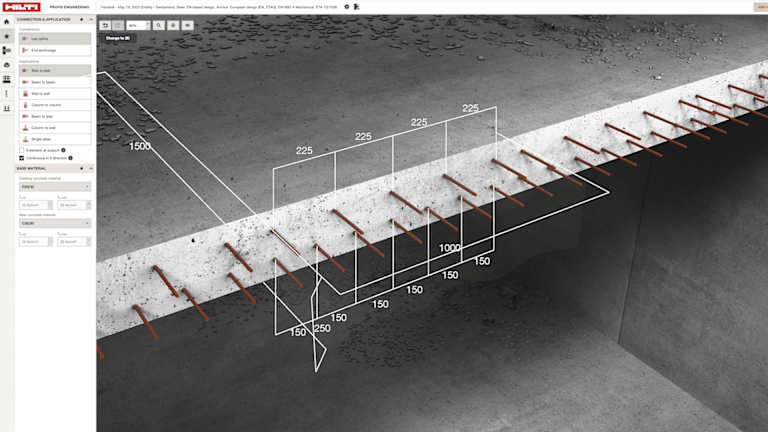
Design and use of Post-Installed Reinforcement for Concrete-to-Concrete connections in Singapore
In today’s construction landscape, Post-Installed Reinforcement (PIR) has become an essential solution for connecting concrete elements cast at different times within reinforced concrete structures. PIR is used across construction projects in Singapore and globally, driven by practical site needs, workflow optimization, and structural retrofitting requirements.
PIR is typically used in:
Unplanned Situations:
PIR is often used to address omissions or errors, such as missing dowels, starter rebars, or couplers—whether due to oversights in construction drawings or deviations during actual construction (e.g., misplaced cast-in reinforcement).Planned Construction Strategies:
In many modern projects, PIR is intentionally incorporated into the workflow. This may be to:
· Avoid rebars / starter bars protruding from formwork, enhancing worker safety and site accessibility,
· Streamline construction sequences by separating concrete pours,
· Allow more flexible logistics and handling during various stages of construction.Structural Enhancement and Retrofitting:
PIR is also a key technique in the strengthening and modification of existing structures, where rebuilding is not feasible or sustainable. Such enhancement activities may be required to:Adapt to changes in functionality of building or structure,
Address damage or deterioration,
Comply with updated design codes and safety standards.

In Singapore, the Eurocodes have been fully adopted as the acceptable standards for structural design . The adoption of Eurocodes extends beyond just design standards. The Eurocodes have a direct relationship with requisite product standards, with technical committees ensuring compatibility of product testing, qualifications and published technical data to provide the correct basis for the design methods.
Due to the addition of the layer of bonding mortar in between rebar and concrete, PIR is unlike conventional cast-in-place reinforcement. The performance of PIR is dependent on the bonding mortar used and is influenced by application conditions such as extended lifetime, installation conditions, elevated temperatures (ambient and fire), etc. No products are equivalent to each other.

To ensure reliable performance during its intended service life and for design to the Eurocodes or EOTA Technical Reports, PIR products are tested and qualified thru vigorous and harmonized technical specifications known as European Assessment Documents (EADs), with the product’s assessed technical characteristics and data published in European Technical Assessments (ETAs)
Engineers need to be aware of the parameters that are assessed for each PIR product and understand the limitations of the technical characteristics of each specific system for the conditions of the structure connection design and usage. Inadequate or wrong considerations from the qualified technical characteristics and data (such as using wrong reduction factors, unqualified technical data, or incorrect installation parameters) can lead to dangerous structural failures or serviceability issues.

To provide clear guidance for the design and use of PIR, the Association of Consulting Engineers Singapore (ACES) and Building and Construction Authority (BCA) have jointly published a Practical Guide for Post-Installed Reinforcement (PIR guide). This PIR guide covers fundamental aspects of PIR qualification, design, installation, quality control aligned with acceptable standards, regulatory environment and good practices in Singapore.
To ensure safe, compliant qualification, design, installation and use of PIR, the following guidance is given in the BCA/ACES PIR guide:
Design of PIR should be done in accordance with SS EN 1992-1, SS EN 1998-1 and/or EOTA technical reports (TR069).
PIR product should be qualified with a European Technical Assessment (ETA) under the requisite European Assessment Document (EAD) 330087 and/or EAD 332402 to suit the adopted design method and application requirement.
The technical characteristics and specifications for PIR (e.g. bond strength, factors for working life, seismic, fire design, installation parameters, etc.) should be obtained from the PIR product’s published ETA.
The PIR should be installed as per the instructions given in the product’s ETA.
PIR installation work should be supervised by appointed site-supervisors.
On-site testing of PIR works (when required) should be performed by SAC-SINGLAS accredited laboratory. On-site testing serves to validate installation quality. It is not for assessment of characteristic performance of PIR systems in standard base materials or to compare products for approval.
The PIR guide also provides summarized design steps and worked examples for common concrete-to-concrete connections. This invaluable resource is available for download at the respective websites of BCA and ACES.
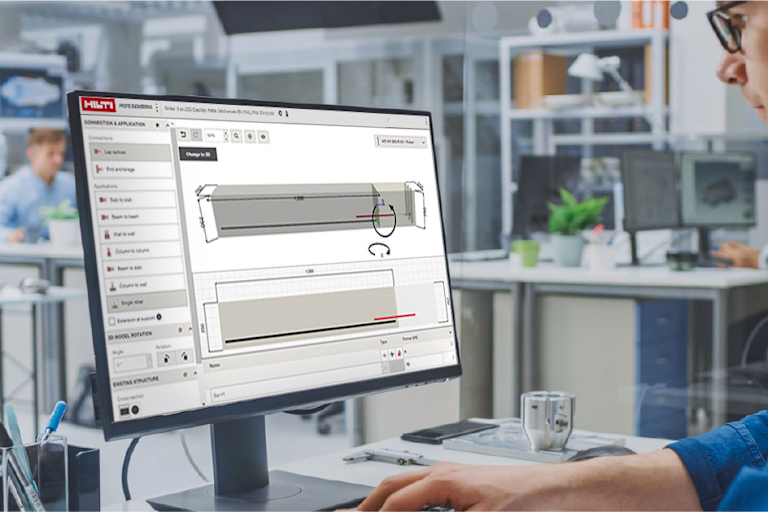
HILTI PROFIS Engineering - An all-in-one software for easy, safe and compliant PIR connection design
Hilti’s PROFIS Engineering Suite makes designing and analyzing PIR connections faster and easier than ever whilst taking considerations of elevated temperature (fire), long-term behavior, seismic, specific connection details etc. using fully qualified and innovative PIR solutions.
PROFIS is part of our SPEC2SITE solutions for structural connections. From structural connection engineering and design to installation on the jobsite, our SPEC2SITE solutions aim to make your projects faster, simpler, safer and more sustainable.